Nella Larsen, Passing, and the Exploration of Race, Class, and Sexuality
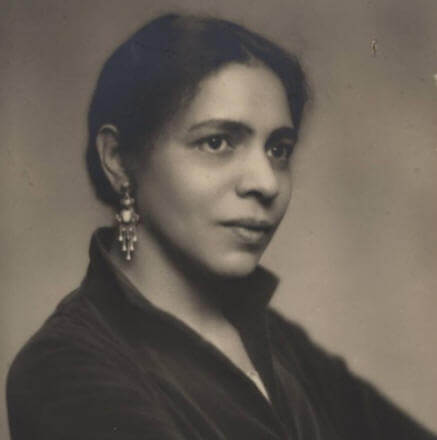
In the area of Chicago in which she grew up, the family encountered an unusual brand of racism: her parents were conspicuously white Europeans, while Nella was of mixed parentage. Her parents moved to a different neighborhood of Chicago for her sake, and often sent her to stay with relatives in Denmark, where she also encountered a degree of racism--however, her time there was comparatively pleasant.
Larsen would grow up to attend the HBC Fisk University in Nashville. Her positioning as a woman of mixed heritage--and her lack of connection to the other African American students there--increased a growing sense of isolation for the young woman. Having grown up in the North, Larsen had no real connection with her contemporaries at Fisk. Having come from the South, where the majority of African Americans originated in the U.S., as well as having descended from American slaves, Larsen could generate little cultural connection with the student body at Fisk. She would later return to Denmark.
In the U.S. she would complete her education at Lincoln Hospital's School of Nursing, and work in the hospital and nursing home. In one capacity her patients were white; in the other, her patients were black. Later she worked as head nurse at the hospital and training school at Tuskegee, but soon became disgruntled with the poor working conditions there and left.
When she married, Larsen found herself adrift alone yet again. Her husband held a doctorate in Physics, and was a member of the elite black upper class of New York. Her background and limited education (by that society's standards) made her a pariah yet again, and Larsen struggled to find a niche (1). After a period of working as a librarian, Larsen began to write short stories, and her first and only short novels, Quicksand and Passing were published. Each focuses on the particular experience of "mixed race" protagonists navigated the troubled margins of race and class. However, Larsen was perhaps among the first to explore the added component of sexuality and its ties to racial identity. H. Jordan Landry explores the ways that Larsen explores questions of lesbian desire under the prevailing trope of race in Passing. She argues that, while the tide in African American literature was drifting toward representations of black subjects as total human beings and finding an art form of its own--separate from white standardizations--Larsen discovers a means for examining woman's identity that departs from conventional notions not just of race but of sexuality. The "Tragic Mulatto," Landry explains in part, was constructed along lines of black masculinity: that her demure and passive nature yielded a racially proud male whose ideology flourished independently of white models of masculinity. As we read, think about the ways Larsen presents us with a female subject struggling with issues of racial identity, meanwhile encoding questions of conventional sexuality.


Comments
Post a Comment